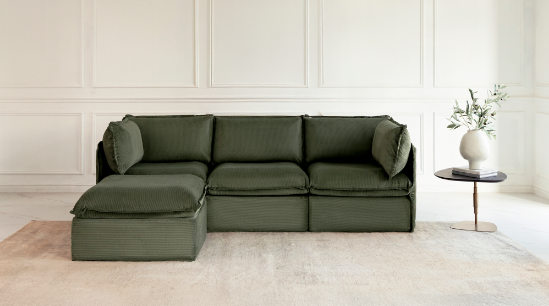
Machine-washable covers give an Anabei couch a practical response to daily use. Its modular construction answers a different question: what happens when the room or household changes? Instead of fixing the seating into one permanent sectional orientation, Anabei uses individual components that can be configured, expanded, and adjusted over time.
That flexibility is a recurring point in Anabei couch reviews, but it becomes more useful when the mechanics are explained. Modularity affects initial planning, moves, future seating needs, cleaning, and the ability to replace one part without replacing the full arrangement.
Starting With the Room That Exists Now
A modular purchase begins with the current floor plan. The household can consider traffic paths, doors, windows, tables, and the number of seats required, then select components for that space. A smaller arrangement is not necessarily a temporary compromise because it can become the foundation of a larger configuration later.
This approach is different from choosing a fixed left-facing or right-facing sectional that remains tied to one room. If the layout changes, Anabei modules can be separated and assembled in a new order. An ottoman or added seat may serve a new purpose without making the original pieces obsolete.
The system is designed for assembly without specialized tools. That makes Anabei’s configurable couch system accessible to the household that uses it, rather than requiring a furniture installer whenever the orientation changes.
Expansion Without Starting Over
Households rarely remain static. A couple may need more seating after starting a family. A move may produce a larger living area, while a later move may call for a reduced footprint. Modular construction lets the arrangement respond in either direction.
Adding a module expands capacity. Removing one creates more floor space. Repositioning pieces can open a walkway or shift the focal point of the room. The value is not an endless number of theoretical layouts, but the ability to make practical changes using compatible components.
Individual components can also be replaced. This supports long-term Anabei modular ownership because localized wear does not automatically require a complete new couch. The structure is treated as a system of serviceable parts rather than one inseparable object.
Washability Supports the Modular Structure
Anabei’s cushion covers and Frame Duvet are fully removable and machine washable. The company recommends a cold, delicate wash and hang drying. Performance fabrics provide liquid and stain resistance before a full wash is needed, and pet-friendly, snag-resistant options are available.
Because the covers are separate from the modules, upkeep can be directed to the areas receiving the most use. Extra slipcovers may be kept for laundry days or used to change the room’s color. The fabric system is PFC/PFAS-free and OEKO-TEX certified, while the foam beneath it is CertiPUR-US certified.
This connection between configuration and care is important. A modular couch that adapts spatially but cannot be refreshed may still reach an early replacement point. Anabei’s washable modular design addresses both the shape of the furniture and the condition of its upholstered exterior.
Selecting the Seating Feel
The modular layout does not dictate a single comfort profile. Anabei offers Deluxe+ Blend, which uses high-resilience foam for a sink-in feel, and Memorix+ Blend, which uses contoured high-resilience memory foam for balanced support and comfort.
Customers can therefore make layout and comfort decisions separately. The same general configuration can be chosen with a softer response or a more contoured one. Both inserts remain within the same washable cover and modular frame system.
For households comparing multiple arrangements, it is useful to consider how the couch will be used. Long lounging sessions, conversation seating, reading, and everyday family use may produce different comfort preferences. Naming the insert makes later product feedback more precise.
Configuration as an Ownership Feature
Modularity is sometimes presented as a collection of options at checkout. Anabei’s more meaningful use appears after delivery, when the household needs the couch to do something different. The ability to expand, reduce, reorient, refresh, or replace a component keeps the purchase connected to later versions of the room.
That is why configuration is not separate from value. It is one of the mechanisms through which the sofa remains useful. When paired with removable covers and extra slipcovers, the modular structure supports both spatial and visual change without making a full replacement the default response.
About Anabei
Anabei is a direct-to-consumer furniture brand under CABA Design. It offers modular couches with removable machine-washable covers, certified performance materials, two comfort inserts, and individually replaceable components. Current layouts are available through the Anabei modular couch collection.
Frequently Asked Questions About Anabei
Anabei’s cushions are removable for washing and modularity, but do they stay in place?
Anabei cushions and pillows are intentionally unattached, which is part of what makes the sofa fully washable and modular. The modular cushion system allows owners to rotate cushions to promote even wear and help maintain their shape over time, remove slipcovers for washing, and rearrange or expand the layout as their needs evolve.
Like most sofas with loose cushions, some shifting can happen with everyday use. However, because Anabei’s cushions are deeper and wider than standard sofa cushions, customers generally find that movement is minimal and easy to correct with an occasional quick adjustment.
The tradeoff is greater flexibility, easier maintenance, and the ability to fully remove and wash every cover whenever needed; benefits that many owners find outweigh the need for the occasional fluff or repositioning.
How well does Anabei hold up in homes with kids and pets?
Families with kids and pets are one of Anabei’s core customer groups.
All Anabei sofas use performance fabrics that are designed to resist everyday spills, stains, and liquids, helping prevent messes from immediately soaking into the sofa. Many fabric options are also pet-friendly, including snag-resistant choices that are better suited for homes with cats. Perhaps the biggest advantage is washability. Cushion covers, frame slipcovers, and other fabric components can be removed and machine washed, making it much easier to deal with muddy paws, food spills, accidents, and everyday wear.
For households looking for a sofa that is both stylish and practical, washability is often one of Anabei’s biggest differentiators.
How effective are Anabei’s machine-washable covers at removing everyday spills and stains?
All Anabei fabrics are designed to be machine washable. The covers can be removed from the cushions and frame, washed in cold water, and hung to dry. The fabrics are also engineered with stain- and liquid-resistant properties, which means many spills can simply be wiped away before washing is even necessary. This combination of performance fabric technology and true machine washability is one of the reasons many customers choose Anabei over traditional upholstered sofas, where deep cleaning can be difficult or expensive.
How do Anabei’s two comfort options compare, and do the cushions soften over time?
Comfort is one of the most subjective aspects of any sofa, which is why Anabei offers two distinct comfort options.
Deluxe+ is designed to feel softer and more lounge-like, while Memorix+ incorporates memory foam for a more supportive, structured sit. Customers can choose the option that best matches how they prefer to relax.
Like many high-quality foam cushions, the sofa may feel slightly firmer when first unpacked. Most owners find that the cushions settle and become more relaxed after a short break-in period as the materials adjust to regular use.
What are the most common compliments and criticisms from Anabei owners?
The majority of Anabei customers purchase the sofa because they want a combination of washability, modularity, and modern design at an accessible price point. Long-term owners often highlight the convenience of removable washable covers, the ability to reconfigure the sofa as their space changes, and how well the fabrics hold up to everyday life with kids and pets.
As with any sofa brand, not every customer has the same preferences. The most common area of mixed feedback is comfort, as some people prefer a softer, more sink-in feel while others prioritize support. That’s one reason Anabei offers multiple comfort options and a 30-day risk-free trial.
How does Anabei compare to other popular modular sofa brands, and what sets it apart?
The right sofa depends on which features matter most to you. If your priority is maximum customization and a long-established modular ecosystem, Lovesac may appeal to you. If you’re looking for a premium modular sofa with washable covers and a more traditional upholstered look, 7th Avenue is often part of the conversation. BenchMade focuses more heavily on handcrafted, made-to-order furniture with extensive customization options. Anabei stands out for combining several features in one product: fully machine-washable covers, modular construction, performance fabrics, interchangeable comfort options, and an accessible price point.
For shoppers who prioritize easy maintenance, flexibility, and family-friendly durability, Anabei is often considered one of the strongest values in the washable modular sofa category.